



Teaching grammar can be a challenging task for many English teachers. Explaining such an academic subject effectively requires both solid knowledge and strong teaching skills. This article shares key grammar points worth focusing on, along with simple and practical ways to teach grammar clearly and effectively for different groups of learners.
Overview of English Grammar Teaching:
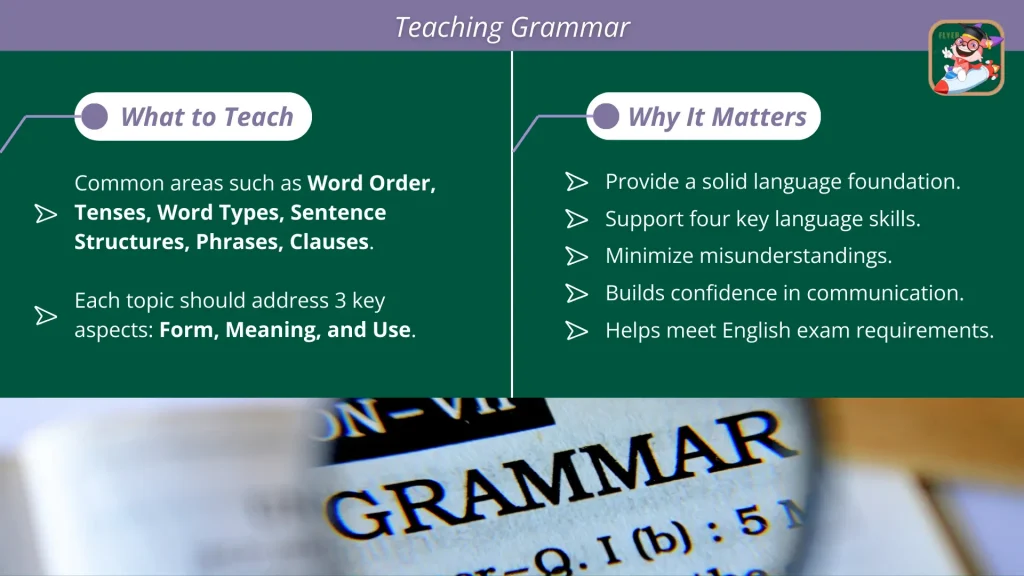
- What to teach: Word Order, Tenses, Word Types, Sentence Structures, Phrases and Clauses.
- Two main approaches: Deductive Approaches and Inductive Approaches.
- Rules: Context, Use, Economy, Relevance, Nurture, Appropriacy.
1. Teaching Grammar: What to Teach and Why It Matters
Teaching grammar covers a wide range of topics. It is not necessary to teach every single grammar point in English; instead, teachers should focus on a few essential areas that help learners meet their specific goals.
Most English learners need to work on key areas such as word order, tenses, word types, sentence structures, phrases, and clauses. Depending on their language level, each group of learners will study different aspects within these areas.
The following suggestions can help teachers decide which grammar points to include in lessons.
For each point, it is important to address all three aspects: form, meaning, and use. Missing any of these may reduce the effectiveness of grammar learning and make the process feel less meaningful or engaging for learners.
Teaching grammar plays a vital role for all learners, from children to adults. It provides a solid language foundation, supports all four skills (listening, speaking, reading, and writing), minimizes misunderstandings, builds confidence in communication, and helps meet English exam requirements when needed.
2. Approaches to English Grammar Teaching
There are several approaches to teaching English grammar, but the most common are: Deductive Approaches (Present rules → Show examples → Practice) and Inductive Approaches (Provide examples → Guide learners to discover rules → Practice).
2.1. Deductive and Inductive Approaches
Deductive and Inductive Approaches represent two contrasting methods in teaching grammar:
- Deductive Approaches follow a traditional teaching style where teachers present rules, provide examples, and guide students through practice. A widely used deductive method is PPP (Presentation – Practice – Production).
- Inductive Approaches start with examples, encourage students to discover grammar rules with some guidance, and then offer practice opportunities. A common example of an inductive approach is task-based learning.
In many English classrooms, both approaches can be combined flexibly to suit learners’ needs and abilities. Some examples include:
- Rule → Example → Practice → Discover again: Teachers briefly present rules (deductive), give examples, and students practice. Later, students rediscover the rules through additional examples (inductive).
- Example → Discover rule → Learn rule → Practice: Students observe examples and guess the rules (inductive). Teachers confirm and explain the rules (deductive), followed by practice.
- Mixed activities: Simple structures are taught directly (deductive), while complex ones are explored through tasks (inductive).
Besides these two main approaches, teaching grammar can be approached differently, as explained in the following sections.
2.2. Other Approaches
Other methods are also widely used in teaching English grammar:
- Traditional approach: Focuses on explicit grammar instruction and written translation, mainly through reading and writing (Grammar-Translation Method).
Example: Teacher explains the rule “The Present Simple expresses habits.” → Students translate: “She goes to school every day.” - Structural approach: Teaches grammar structures in sequence through systematic practice and drills.
Example: Teacher presents the structure “Subject + Verb + Object.” → Students repeat and substitute: “I play football.” – “We play football.” – “She plays football.” - Notional-functional approach: Organizes lessons around notions (situations) and functions (communicative purposes) rather than isolated grammar rules.
Example: For the topic “Talking about daily routines,” as students learn structures such as “I usually …” or “She often …” to describe habits. - Communicative approach (CLT): Emphasizes real-life communication as both the goal and the tool for learning grammar.
Example: In a role-play “What do you do every day?”, students ask “What do you usually do in the morning?” and answer “I play the guitar.”
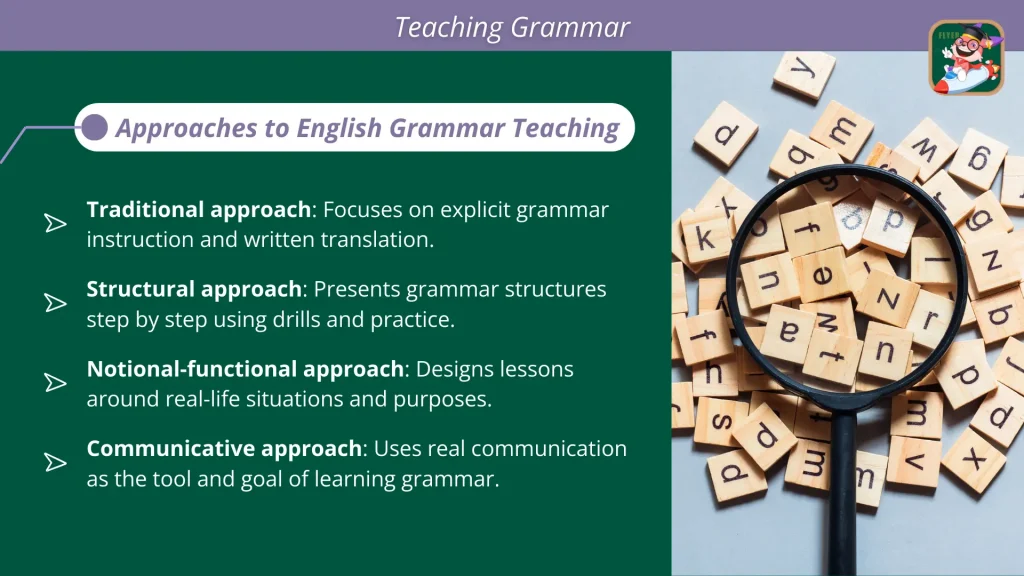
Depending on lesson goals, teachers can combine these approaches to make grammar learning more meaningful and less stressful for learners.
3. Key Principles for Teaching Grammar
The ultimate goal of teaching grammar is to help learners use English accurately and effectively. To achieve this, teachers should keep in mind six key principles for teaching grammar: Context, Use, Economy, Relevance, Nurture, and Appropriacy. These principles apply to all approaches, methods, and grammar topics.
3.1. Context
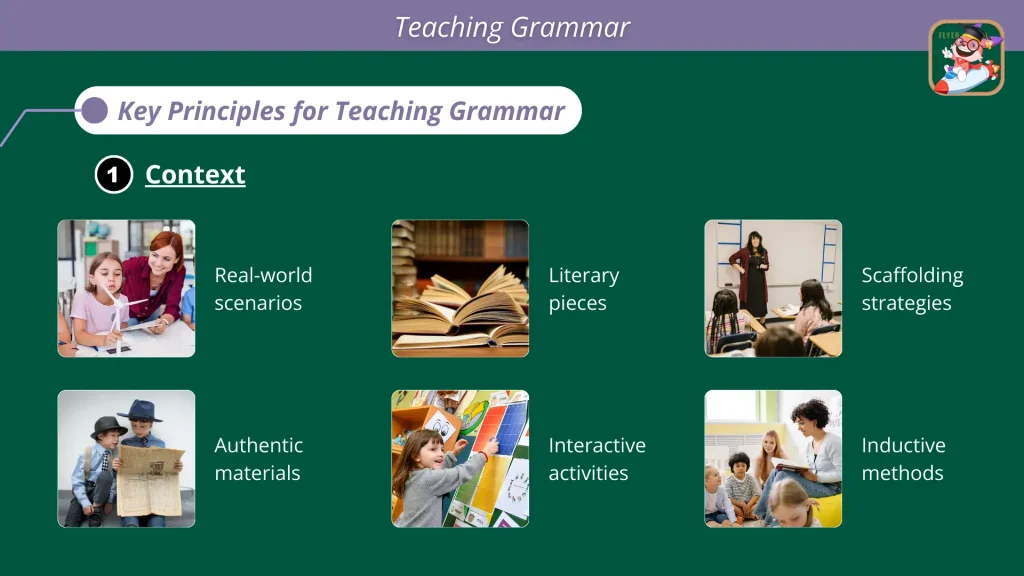
Linking specific English grammar forms to meaningful contexts helps learners grasp the purpose behind each structure, understand the intended meaning, and build a clearer sense of how to use the target language effectively.
To bring context into teaching grammar, teachers can use:
- Real-world scenarios
- Authentic materials
- Literary pieces
- Interactive activities
- Scaffolding strategies
- Inductive methods
3.2. Use
The main goal of teaching English grammar is to help students understand and use the language effectively, rather than learning it passively. Students need to see how a grammar point works in real-life communication so they can stay motivated to develop their language skills further.
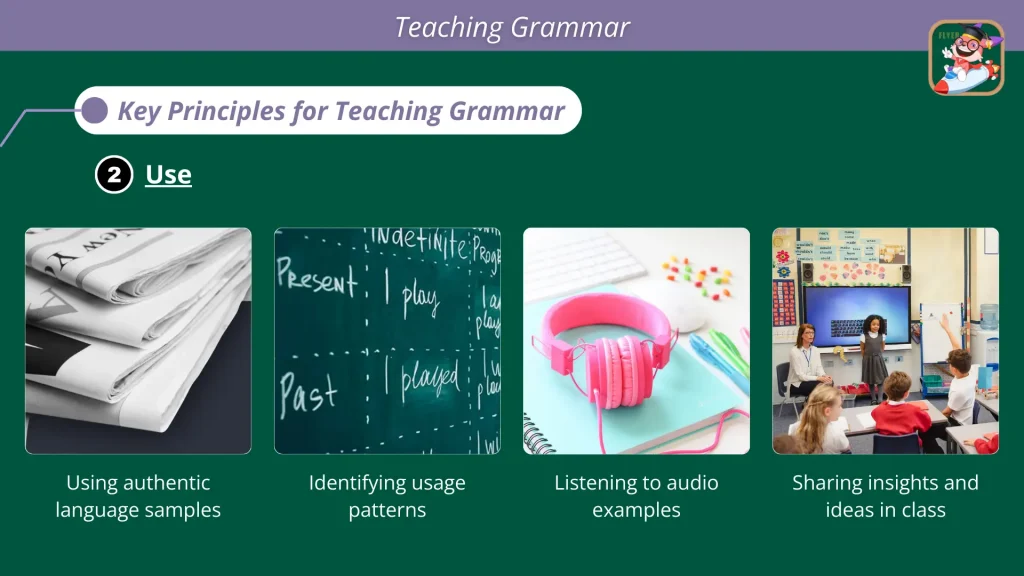
Based on this principle, teaching grammar should be combined with spoken interaction or communicative production tasks, such as:
- Using authentic language samples
- Identifying usage patterns
- Listening to audio examples
- Sharing insights and ideas in class
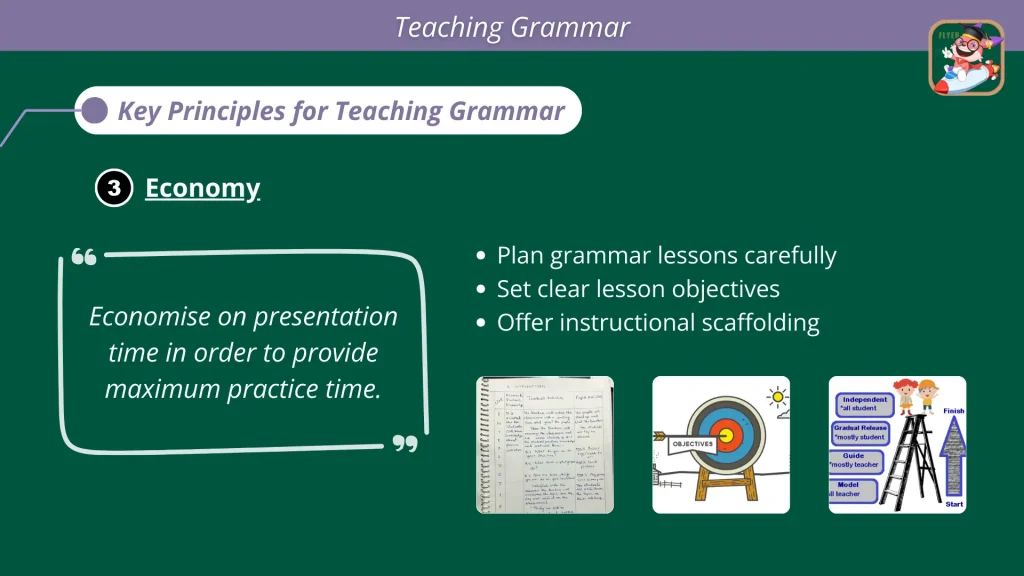
3.3. Economy
“Economise on presentation time in order to provide maximum practice time.” – Thornbury (2004)
“Comprehensive input is language input that can be understood by listeners despite them not understanding all the words and structures in it.” – Krashen (2003)
Providing comprehensive input and more practice time allows students to acquire and use English naturally without being overly constrained by accuracy. The more students use the language, the better they understand it.
To maximize practice time and make it effective in teaching grammar, consider the following:
- Plan grammar lessons carefully
- Set clear lesson objectives
- Offer instructional scaffolding
3.4. Relevance
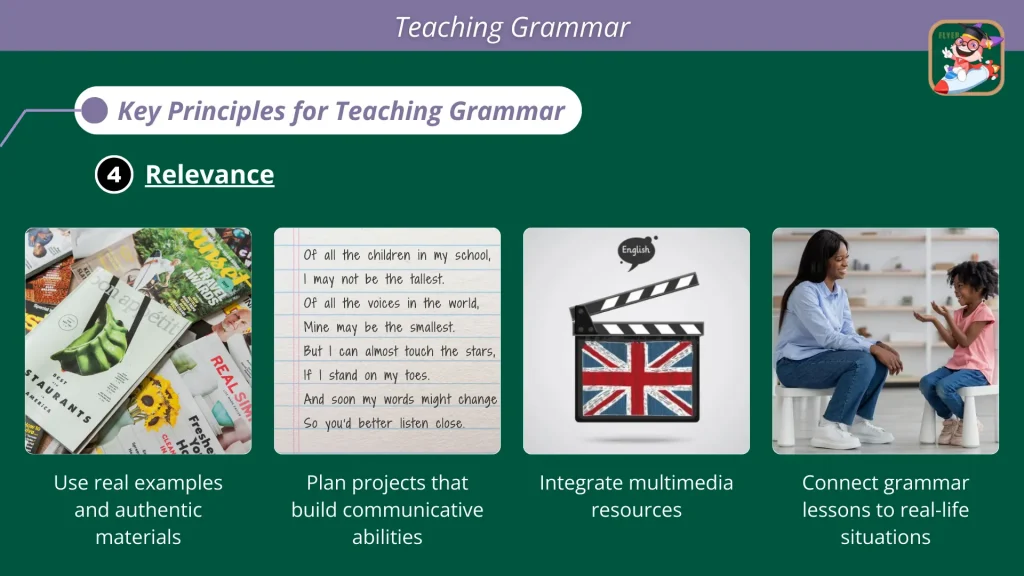
Students tend to overlook grammar points when they fail to see their importance. In contrast, they become more engaged when they understand the relevance and value of a grammar point in real-life contexts.
Grammar points should be connected to students’ needs and introduce something new to spark curiosity. When learners find a grammar point worth exploring, they are more likely to focus and participate actively in lessons.
Another effective approach in teaching grammar is linking the target language structures with those in students’ native language to deepen understanding.
To make teaching grammar more relevant, teachers can:
- Use real-world examples and authentic materials.
- Design interactive activities and projects that highlight students’ communicative skills, such as publishing poems or stories.
- Integrate multimedia resources (movies, audios, interactive games, etc.).
- Connect grammar lessons to real-life situations or problems.
3.5. Nurture
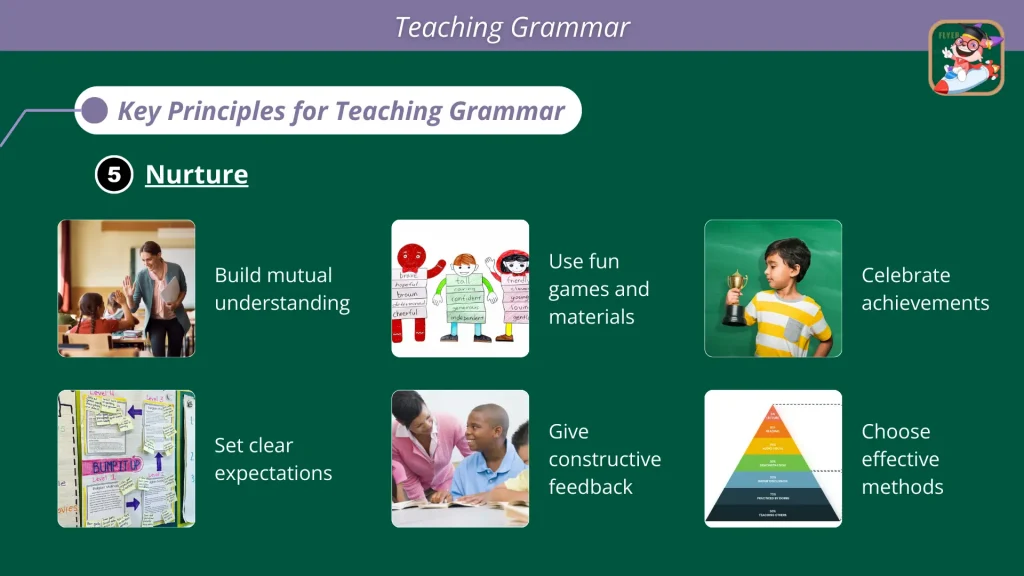
Creating a safe and supportive environment where students can experiment, make mistakes, and learn from them is essential in teaching grammar. A classroom that fails to reinforce self-esteem often leads students to withdraw and lose interest in learning.
Ways to maintain a nurturing environment when teaching grammar include:
- Build mutual understanding between teachers and students.
- Set clear academic and behavioral expectations.
- Use interactive games, engaging materials, and discussions.
- Give constructive, nonjudgmental feedback.
- Celebrate individual and group achievements.
- Choose effective methods to boost motivation and creativity.
3.6. Appropriacy
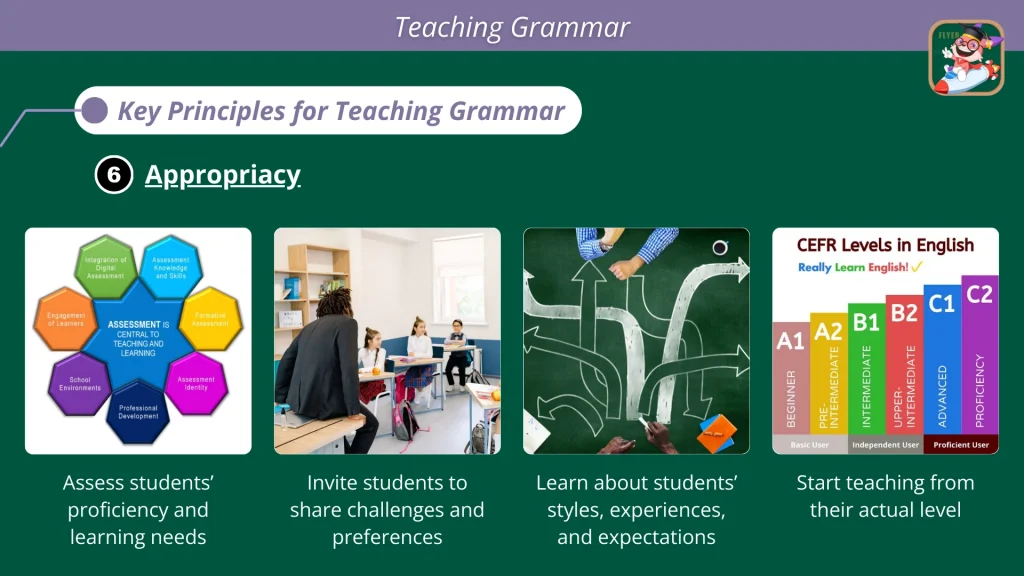
Individual differences greatly influence a class’s overall learning goals. With such diversity, teachers need to identify what students already know, what they need most at the moment, and what they should learn in the future. This helps create equal learning opportunities for all students and supports them in achieving their goals.
To ensure appropriacy in teaching English grammar, teachers can:
- Conduct needs assessments or diagnostic tests to gather data on students’ proficiency levels and learning needs.
- Encourage students to share their language learning challenges and preferred support methods.
- Identify students’ learning styles, previous experiences, and current expectations.
- Begin teaching from learners’ actual starting point.
4. Teaching English Grammar Activities
Teaching grammar can be boring without interactive tasks, especially for young learners. The following suggestions offer creative ways to design fun, effective, and classroom-friendly grammar activities.
4.1. Organizing Grammar Games
Integrating game elements into grammar practice can bring more benefits than using traditional exercises alone. Some key advantages of grammar games include:
- Creating a fun and engaging learning experience that boosts motivation.
- Supporting natural and effective language acquisition and retention.
- Developing additional skills beyond language, such as logical thinking and social interaction.
For ready-to-use ideas, teachers can explore this article featuring 35+ simple grammar games. Although designed mainly for young learners, these games can be easily adapted for English learners of all ages.
When designing grammar games, the following principles should be considered:
- Align with lesson objectives, target grammar points, and curriculum.
- Use clear, engaging game mechanics with timely rewards and penalties to encourage participation.
- Keep rules simple and easy to follow so learners can focus on grammar practice itself.
- Promote interaction through communication, idea sharing, or teamwork.
- Personalize games according to learners’ English levels, age, needs, and learning habits.
Whether using ready-made games or designing new ones, the main goal remains the same: ensuring that students understand, remember, and know how to apply grammar after the games end. The focus should always stay on learning outcomes rather than on the game design itself.
4.2. Using Tools
With technology advancing fast today, teachers who do not make use of available tools in teaching grammar may miss valuable opportunities. These tools help optimize grammar instruction and make lessons more effective.
In addition to platforms for organizing activities and grammar games, teachers can explore tools for other purposes, such as:
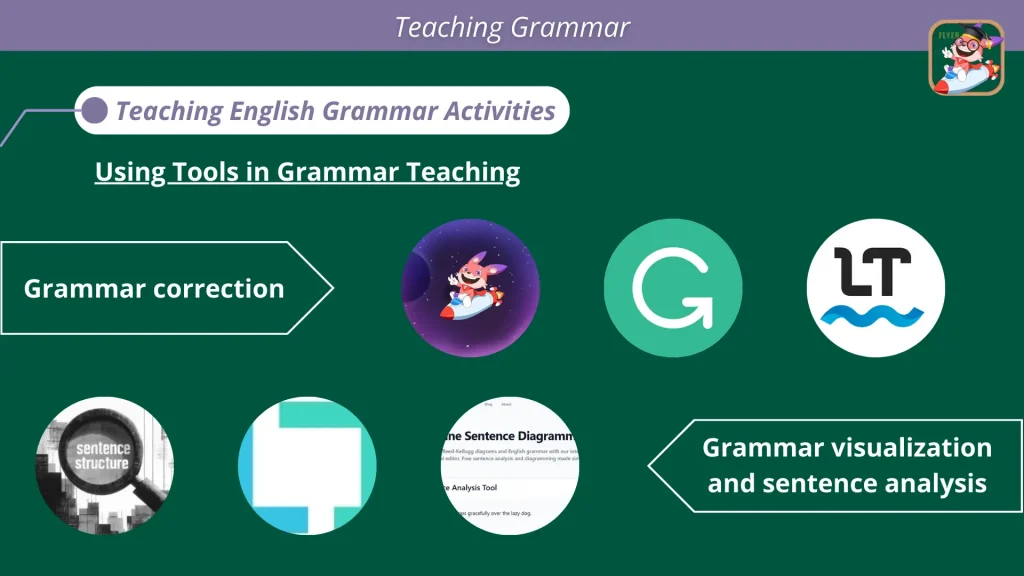
- Grammar correction: FLYER.us, Grammarly, LanguageTool.
- Grammar visualization and sentence analysis: SentenceVizu, Let’s Diagram, Sentence Structure Analyzer.
While grammar tools are convenient, they should be used thoughtfully and in moderation, integrated appropriately into teaching processes.
4.3. Breaking into Mini Lessons
Mini lessons usually last 5-15 minutes, designed to teach a specific point clearly and concisely, allowing learners to apply it immediately.
For example, instead of teaching all aspects of the present simple tense in one lesson, teachers can divide it into:
- Mini lesson 1: Usage – habits and hobbies.
- Mini lesson 2: Verb forms – adding “s” for third-person singular. E.g. She likes apples.
- Mini lesson 3: Questions with Do/ Does. E.g. Do you like apples?/ Does she like apples?
→ Each mini lesson targets a single aspect of the tense (usage, structure, verb forms, etc.) and includes brief examples and short practice activities.
A successful strategy for mini lessons is Mini lessons online – Practice offline. Teachers provide mini lessons online for students to study independently at home, followed by in-class activities for practice and interactive learning with peers and teachers.
4.4. Storytelling
Learning grammar through stories makes knowledge more vivid and meaningful, as it helps learners understand how to apply grammar in real-life contexts. When selecting a story, teachers should consider students’ age, English level, and interests. A story that is not relatable may become boring, causing learners to lose focus and making it harder to retain and use the grammar effectively.
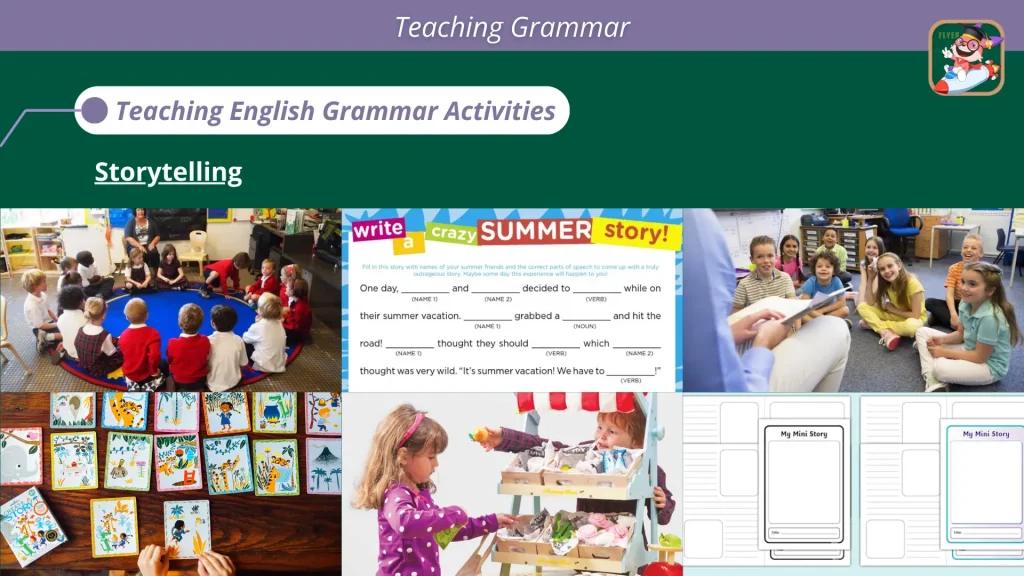
Suggested storytelling activities for teaching grammar:
- Storytelling circle: Students contribute one idea each to create a complete story.
- Guided storytelling: Students complete a teacher-provided story by filling in grammar-focused gaps.
- TPRS (Teaching Proficiency through Storytelling): Teachers tell a story using the target grammar point, then asks questions, has students retell it, or write a short text with the same grammar focus.
- Sequencing: Students arrange sentences or images to form a coherent story.
- Role-play: Students act as characters in the story, using the target grammar.
- Digital storytelling: Students create stories with images, sound, or video and present them to their class.
Teachers can adapt these activities or design new storytelling tasks to suit different classroom needs.
4.5. Using Songs
A study at Kasetsart University (Thailand) showed that students taught grammar through songs made significantly greater progress than those in traditional classes. Many studies have also confirmed the powerful role of music in language learning.
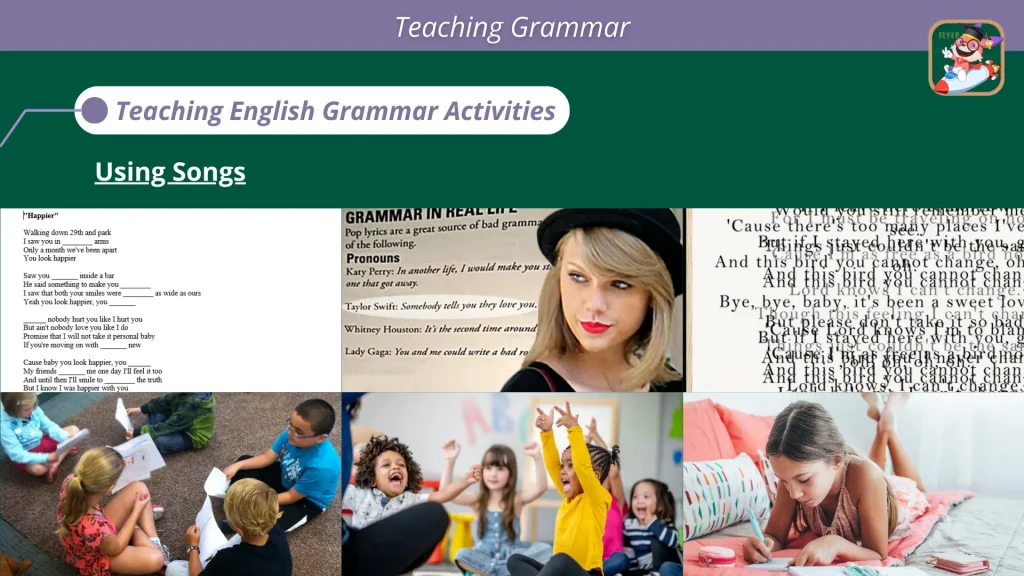
Songs can be used for a variety of grammar activities, such as:
- Gap-fill: Fill in missing words in lyrics.
- Musical grammar pieces: Identify and correct grammar structures in lyrics.
- Lyric scramble: Rearrange jumbled lyrics into the correct order.
- Lyrical reading: Listen, take notes, and search for grammatical forms in lyrics.
- Personal response: Share opinions and feelings after analyzing a song.
- Sing-along / Call-and-response: Sing along or interact with teachers and peers.
- Song-based projects: Write new lyrics, create rap versions, or develop creative projects based on a song.
When using songs in teaching, it is important to focus on the overall meaning before addressing specific language features. This allows students to build an emotional connection and learn grammar in a more natural, meaningful way.
4.6. Role-playing
Role-play is one of the most popular language teaching activities nowadays. It suits different groups of learners and brings several practical benefits:
- It allows learners to apply grammar knowledge directly to real-life situations.
- It encourages active participation, helps build confidence, reduces fear of making mistakes, and supports faster learning and effective grammar use.
- It develops other essential skills such as communication, teamwork, and problem-solving.
Teachers can start with prepared scripts and clear role assignments. As learners become familiar with role-playing and gain confidence, they can lead the activity and develop realistic situations for more natural language practice.
Below are some tips for making grammar role-plays engaging and effective in English classrooms:
5. Important Things to Note in Grammar Teaching
In teaching grammar, teachers may make mistakes or face challenges in handling certain issues. This section of FLYER highlights the most common situations, helping teachers prepare more effectively for upcoming grammar lessons.
5.1. Common Mistakes in Teaching Grammar
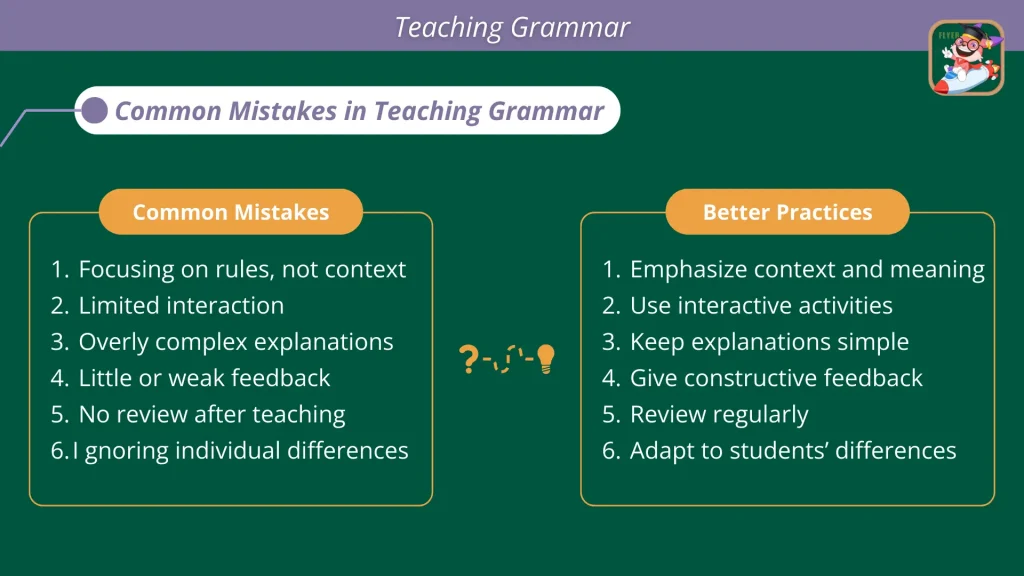
Many teachers make mistakes when teaching grammar, such as:
- Overemphasizing rules while ignoring context
- Lack of interaction and overlooking some students
- Explaining with overly complex language
- Providing little or ineffective feedback
- Failing to review grammar after teaching
- Ignoring individual differences among students
To address these issues, teachers should:
- Prioritize context and meaning over strict rules
- Encourage learning through activities and interaction
- Explain simply, avoiding complex terminology.
- Give practical, constructive feedback
- Plan regular review sessions, rather than teaching once and moving on
- Respect students’ differences and adapt teaching methods accordingly
Making mistakes is inevitable, especially for beginner teachers. However, following these guidelines can make teaching grammar more effective and enjoyable.
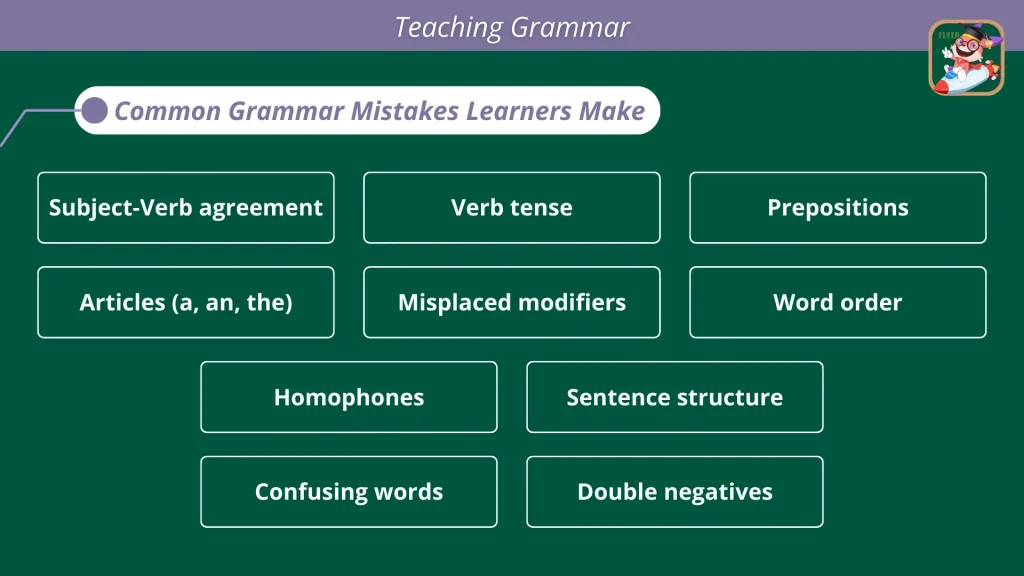
5.2. Common Grammar Mistakes Learners Make
Recognizing common grammar mistakes students make helps teachers stay focused and improve learning outcomes. Students often struggle with errors related to:
| No. | Common Grammar Mistakes | Examples of the Mistakes |
|---|---|---|
| 1 | Subject-Verb agreement | She go to school. |
| 2 | Verb tense | I will go yesterday. |
| 3 | Prepositions | I’m interested on Math. |
| 4 | Articles (a, an, the) | I saw a elephant. |
| 5 | Misplaced modifiers | I saw a dog running with a bone down the street. |
| 6 | Word order | Yesterday went she to the park. |
| 7 | Homophones | Their going home. |
| 8 | Sentence structure | Because it was raining. (Fragment) |
| 9 | Confusing words | I always loose my keys. |
| 10 | Double negatives | I don’t have no money. |
When students make grammar mistakes, teachers should:
- Maintain a positive attitude and avoid embarrassing students for errors.
- Focus on key errors relevant to the lesson, rather than correcting everything.
- Encourage students to identify and correct their own mistakes through guiding questions.
- Correct errors gently and naturally, for example, by repeating correct sentences for imitation instead of emphasizing mistakes.
- Focus on sentence meaning before grammar accuracy.
- Recognize students’ efforts, not only their errors.
6. Materials
The Internet offers a wealth of useful materials for teaching English grammar. To help teachers save time selecting resources, FLYER has compiled the most trusted grammar materials and provides sample lesson plans below for reference.
Sample English grammar lesson plan:
Grammar Worksheets (FREE Download):
- Worksheet 1: https://agendaweb.org/grammar/articles-worksheets-resources.html
- Worksheet 2:
FREE B1 & B2 Grammar Worksheets: http://www.english-practice.at/index.htm
Recommended books for teaching English grammar:
- How to teach grammar – Scott Thornbury
- Practical English Usage – Michael Swan
- Oxford A-Z of Grammar and Punctuation – John Seely
- The English Tenses – Phil Williams
- The Best Grammar Workbook Ever! – Arlene Miller
7. FAQs about Teaching Grammar
Yes, children can acquire grammar naturally through exposure and immersion – hearing and using grammar in meaningful contexts – without formal lessons. This is explained by rapid brain development, strong imitation skills, and curiosity, especially in children aged 0-6.
In teaching English grammar, it is important to focus on common areas such as Word Order, Tenses, Word Types, Sentence Structures, and Phrases and Clauses. Each topic should consistently address three key aspects: Form, Meaning, and Use. By considering learners’ level, age, and learning goals, teachers can choose the most suitable grammar points while ensuring these aspects are fully covered.
The three P’s of teaching grammar – Presentation, Practice, and Production – is a structured teaching method where new language points are introduced, reinforced through guided activities, and then applied in a more communicative way. This method works well for beginner and lower-intermediate learners.
Teachers should move from basic to more complex knowledge. Two suggested sequences include:
– Parts of Speech → Simple sentence structure → Simple verb tenses → Complex sentence structures & grammar concepts.
– Nouns & Pronouns → Verbs → Articles → Simple structures (+, -, ?) → Tenses → Adjectives & Adverbs → Prepositions → Conjunctions.
The sequence should be chosen based on learners’ needs.
There are three common reasons why grammar is no longer a focus in many English classrooms:
– innovations in pedagogical approaches,
– the dominance of standardized testing priorities,
– and doubts about the effectiveness of traditional teaching methods.
However, many educators still advocate teaching grammar, but recommend integrating it into the core language skills – listening, speaking, reading, and writing – rather than teaching it as a separate subject. Moreover, grammar instruction should be practical and accessible, ensuring it supports communication instead of creating barriers for learners.
For effective teaching grammar to beginners, teachers should:
– Keep it simple.
– Check understanding regularly.
– Give plenty of practice time.
– Show, don’t just tell.
– Use positive reinforcement.
– Make lessons engaging.
Grade 5-6 (ages 10-11) is considered an appropriate stage to begin teaching grammar through formal instruction. At this age, learners develop logical and abstract thinking skills, enabling them to analyze, synthesize, and draw conclusions more effectively. These cognitive abilities help them acquire grammar knowledge more easily and deeply than at earlier stages.
However, children usually start understanding and using correct grammar naturally, even before they learn to speak. This happens through early exposure to the language, listening, and real-life interactions.
Therefore, besides formal instruction, teachers should also integrate informal instruction to make teaching grammar more effective and engaging for learners.
To write an effective grammar lesson plan, teachers need to:
– Select grammar points that suit learners’ needs.
– Choose appropriate approaches (deductive, inductive, etc.).
– Design lesson content and activities that follow the six rules of teaching grammar.
– Include all essential elements of a lesson plan, such as class description, lesson aims and objectives, key grammar focus, and main teaching methods (the sample lesson plan provided in this article can be a helpful reference).
– Note common learner errors for future improvement.
Also, adding creativity can make grammar lessons more practical and engaging for students.
Conclusion
In summary, teaching grammar can feel challenging, but it becomes much easier when guided by three key elements: simplicity, practicality, and relevance. With these in mind, grammar lessons can be both effective and enjoyable, helping teachers and students achieve better learning outcomes.
Read more


 and deductive vs. inductive methods for better learning outcomes.)